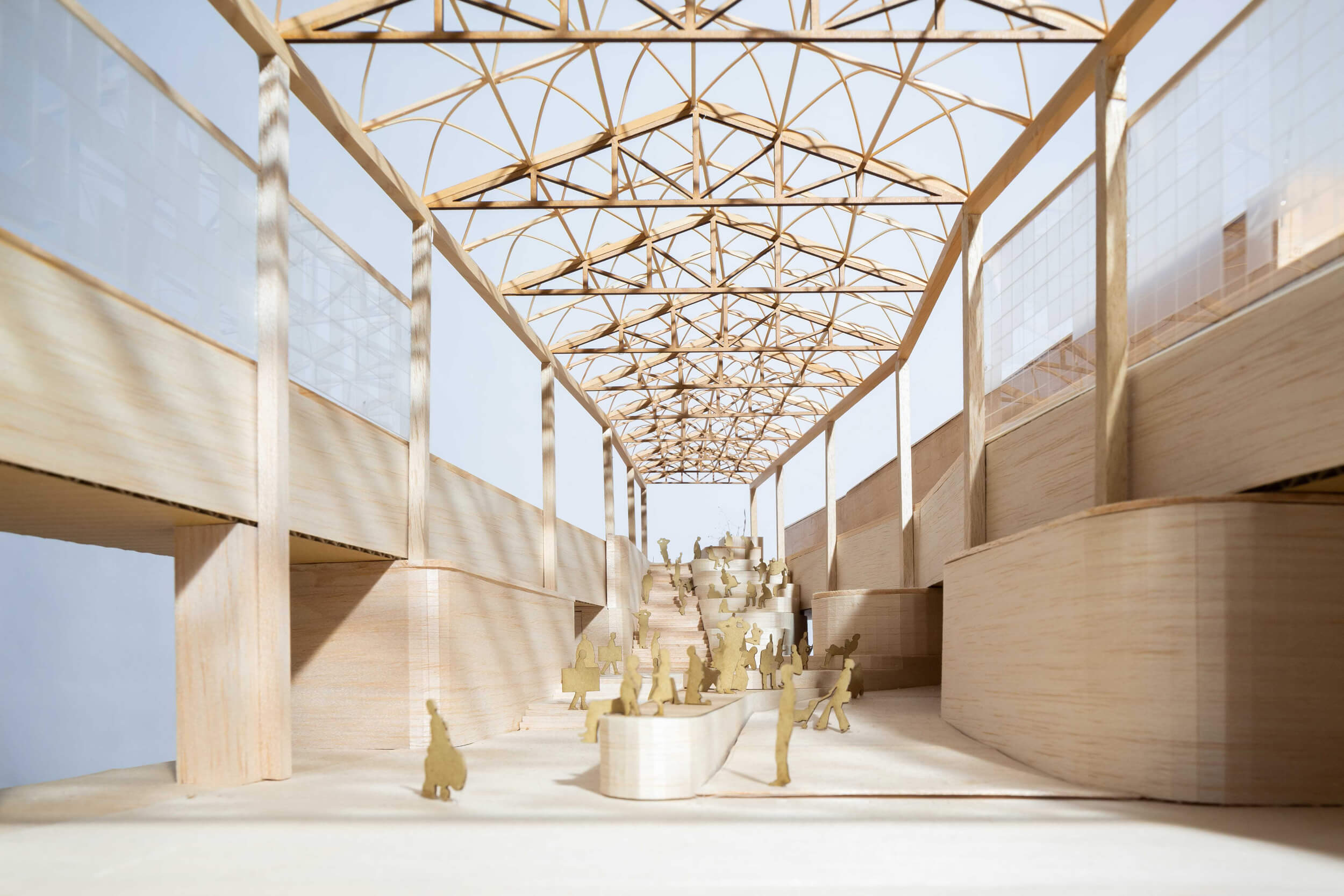
In the wards of Tokyo, evacuation destinations are assigned to each district. Large-scale parks and university campuses are designated as evacuation places in the time of disaster. Although Takadanobaba Station is located at the boundary of these allocated districts and within distance to designated evacuation sites, the number of users is higher than 200,000 people per day on the Yamanote line. How can the station function as an evacuation site in the event of a disaster? In any case, the interior of the building must be „safe“ as there is always the possibility of objects falling down from the ceiling. There are many hanging elements found in station building, such as signs, lighting, cables etc., from the ceiling and integrated into the wall. When it is necessary to suspend something, it is important to make it light using a soft material. While the methods to fix these elements may be strengthened, if nothing is hung then nothing will fall. Looking carefully to the ceiling surface of Takadanobaba station, there is extra space bet- ween the elevated tracks. Widen the space hidden by the existing kiosk, made into steps and exposed to the user with the lower part is made as storage for emergency goods. The ceiling is raised and the roof is made with a permeable fluorocarbon resin to illuminate the space even during a power failure. Flow lines to the platform are connected by a smooth slope and a flat curved line, which will guide the daily use of the space and also help the evacuation process at the time of disaster. This plan can be seen to work only in the time of emergency. However, if the everyday use of stations can be assembled so as to overlap with functions as evacuation space, wouldn’t evacuation drills become part of our daily life?
Student: Rocio Calzado
- All
- 2009_Behavior Around Windows
- 2012_Bike Town Tokyo
- 2013_Without Venturi
- 2014_Tokyo Pallazzo
- 2015_Architecture for Biodiversity
- 2015_Sagata Livelihood Observatory Public Drawing
- 2015_佐潟なりわい観測舎
- 2015_佐潟なりわい観測舎
- 2015_佐潟なりわい観測舎
- 2016_Constructing Tokyo Commons
- 2017_Slowgraming Tokyo
- 2018_Yamanote-line Lab
- 2019_Thing of Modernity
- 2019_Variete / Architecture / Desire
- 2019_Window Scape 8 -A Window Between Ethnographic Relations and Industrial Society-
- 2020_Non-Binary City
- 2020_Ochestrating Unpredictablity in Tokyo
- 2021_Ugly Architecture?
- 2022_Miss Behavior
- 2023_Sing a Song
- 2024_The power of drawing
- MADE IN TOKYO
- Thing of Modernity – Mapping the Micro-geography of Everyday Environments
- 佐潟なりわい観測舎