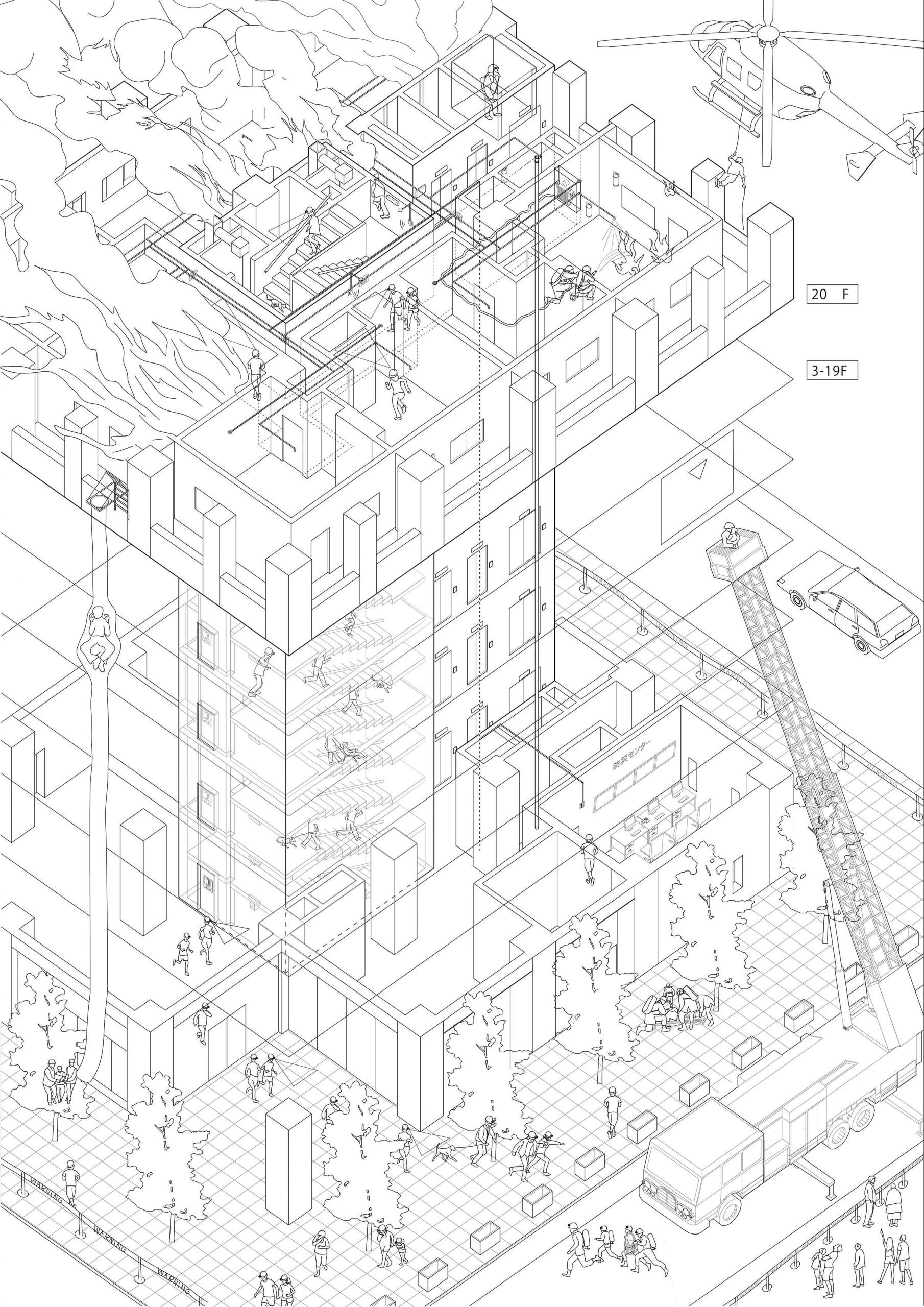
From the Meiji Period to today the techniques of firefighting have shifted from the protection of a district, with large main streets or fire-resistant storehouses providing firebreaks, to en-masse fire-protected buildings, ensuring people’s ability to escape a conflagration. In the post-war period, with the densification of Tokyo, the vertical concrete staircases in multistory buildings—which themselves served as firebreaks along the main streets—became the major escape route, complemented by various types of devices that can be used from balconies or windows. In contemporary high-rises the common circulation system has become host to an entire emergency system, with smoke and gas detectors, alarms connected to ground-floor emergency centers, sprinklers, fireproof staircases, special emergency fire-fighter elevators, and even rooftop helicopter landing-pads.
Student: Shiqui Liang
- All
- 2009_Behavior Around Windows
- 2012_Bike Town Tokyo
- 2013_Without Venturi
- 2014_Tokyo Pallazzo
- 2015_Architecture for Biodiversity
- 2015_Sagata Livelihood Observatory Public Drawing
- 2015_佐潟なりわい観測舎
- 2015_佐潟なりわい観測舎
- 2015_佐潟なりわい観測舎
- 2016_Constructing Tokyo Commons
- 2017_Slowgraming Tokyo
- 2018_Yamanote-line Lab
- 2019_Thing of Modernity
- 2019_Variete / Architecture / Desire
- 2019_Window Scape 8 -A Window Between Ethnographic Relations and Industrial Society-
- 2020_Non-Binary City
- 2020_Ochestrating Unpredictablity in Tokyo
- 2021_Ugly Architecture?
- 2022_Miss Behavior
- 2023_Sing a Song
- 2024_The power of drawing
- MADE IN TOKYO
- Thing of Modernity – Mapping the Micro-geography of Everyday Environments
- 佐潟なりわい観測舎