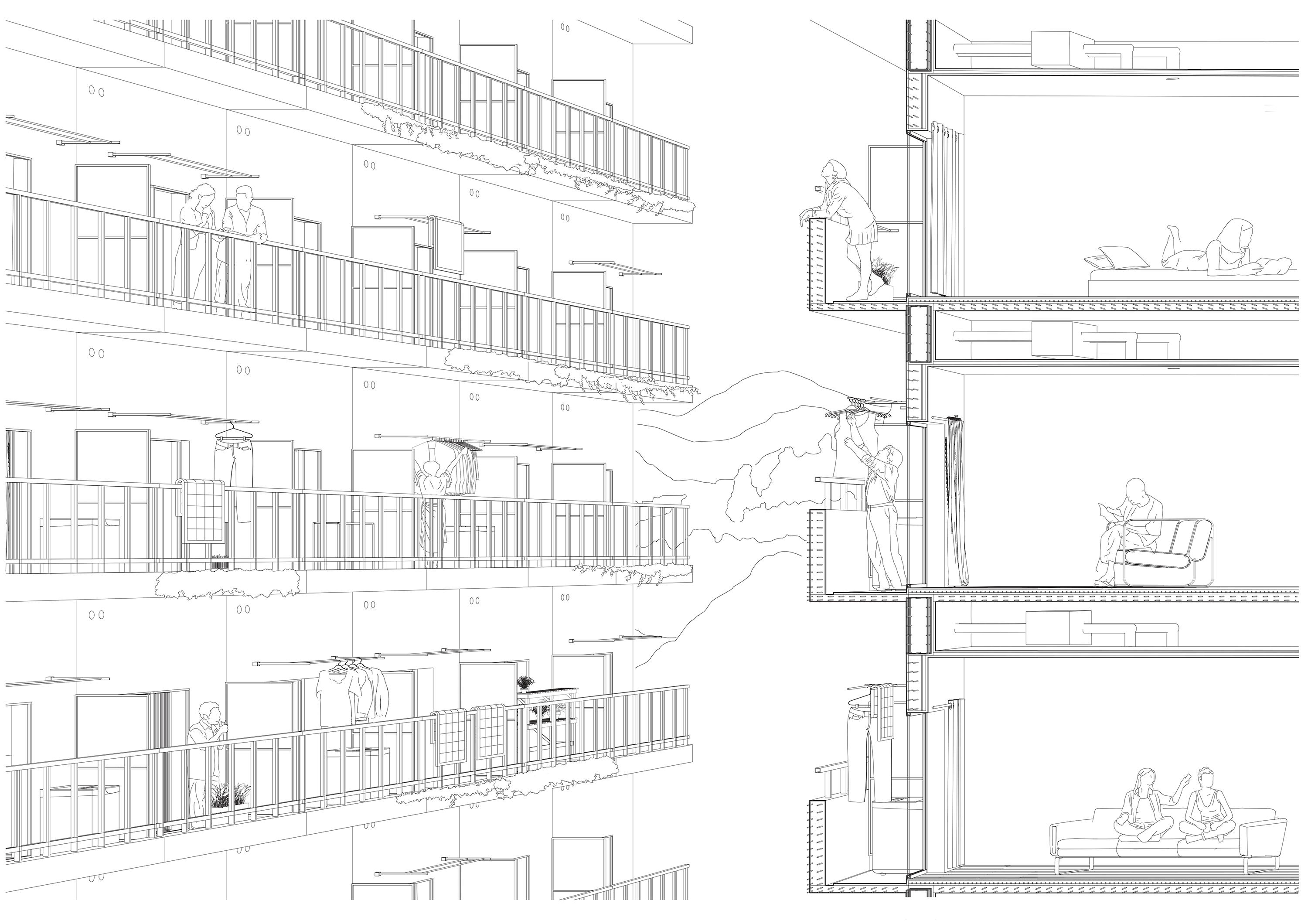
The history of the exterior partition-wall in the Japanese house seems to run in an opposite direction to the modern European one: from a succession of spatially differentiated thresholds to an overall technical ensemble. In the pre-modern period the building envelope was defined by its rich depth, which often embraced the entire house and its garden, forming a multi-layered and porous interaction between outside and inside. The enclosure of the post-war Japanese house, on the other hand, is reduced to a solid wall assembled out of mass-produced elements, leading to the collapse of the spatial multi-layeredness and its replacement by several functionally clearly delimited elements, namely the compact wall and its various openings, such as sash windows, air-conditioners, steam outlets, etc. In recent condominiums the wall has become defined by its increasing technological dependence, with a double, often contradictory goal: an ideal tightness of the enclosure and a series of highly controlled openings, gradually cutting off the inhabitants from their natural outside environment while creating a highly artificial one on the inside.
Student: Veronica Thorve
- All
- 2009_Behavior Around Windows
- 2012_Bike Town Tokyo
- 2013_Without Venturi
- 2014_Tokyo Pallazzo
- 2015_Architecture for Biodiversity
- 2015_Sagata Livelihood Observatory Public Drawing
- 2015_佐潟なりわい観測舎
- 2015_佐潟なりわい観測舎
- 2015_佐潟なりわい観測舎
- 2016_Constructing Tokyo Commons
- 2017_Slowgraming Tokyo
- 2018_Yamanote-line Lab
- 2019_Thing of Modernity
- 2019_Variete / Architecture / Desire
- 2019_Window Scape 8 -A Window Between Ethnographic Relations and Industrial Society-
- 2020_Non-Binary City
- 2020_Ochestrating Unpredictablity in Tokyo
- 2021_Ugly Architecture?
- 2022_Miss Behavior
- 2023_Sing a Song
- 2024_The power of drawing
- MADE IN TOKYO
- Thing of Modernity – Mapping the Micro-geography of Everyday Environments
- 佐潟なりわい観測舎