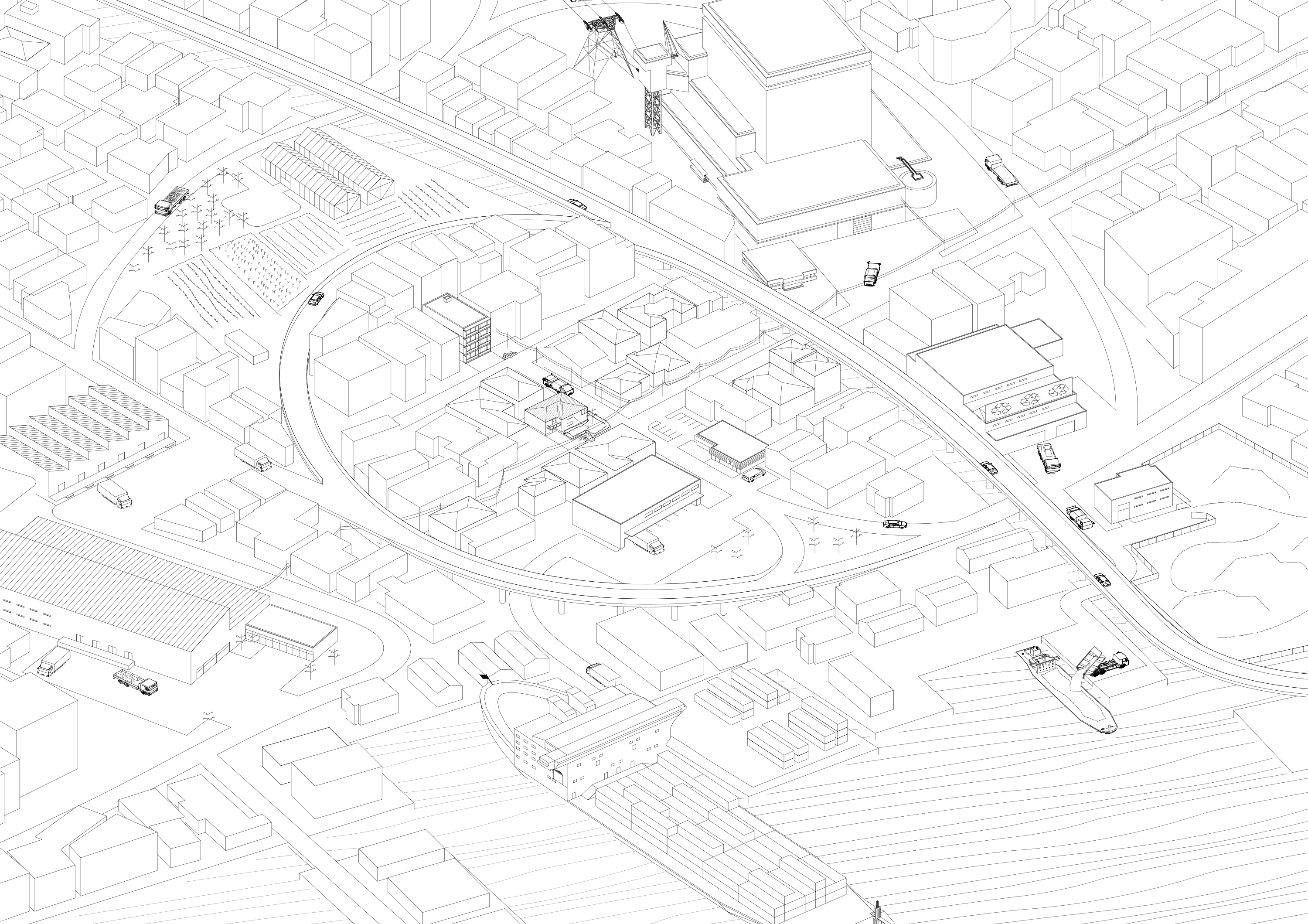
While in the early Meji Period the disposal of waste was part of a spatially limited and circular network, linking agricultural fields with markets and houses, and from there, when not recycled, again to the fields, the economic and demographic growth of the post-war period, especially in Tokyo, saw the introduction of public waste collection, primarily disposed of in landfills. This unilinear processing from production to consumption began to be increasingly called into question, starting in the mid-1980’s with the introduction of a new recycling system involving an evermore refined rubbish separation for recyclable goods, the exploitation of mix-waste for energy in large power stations, and hazardous waste being exported and reprocessed overseas. The waste-management system has thus evolved into a large, complex, and sometimes invisible chain involving multiple actors. Waste is no longer perceived as either a purely homogenous and useful resource or solely as landfill material, but rather as consisting of different constituents with varying values and repurposing potentials.
Student: Wongphan Nawin
- All
- 2009_Behavior Around Windows
- 2012_Bike Town Tokyo
- 2013_Without Venturi
- 2014_Tokyo Pallazzo
- 2015_Architecture for Biodiversity
- 2015_Sagata Livelihood Observatory Public Drawing
- 2015_佐潟なりわい観測舎
- 2015_佐潟なりわい観測舎
- 2015_佐潟なりわい観測舎
- 2016_Constructing Tokyo Commons
- 2017_Slowgraming Tokyo
- 2018_Yamanote-line Lab
- 2019_Thing of Modernity
- 2019_Variete / Architecture / Desire
- 2019_Window Scape 8 -A Window Between Ethnographic Relations and Industrial Society-
- 2020_Non-Binary City
- 2020_Ochestrating Unpredictablity in Tokyo
- 2021_Ugly Architecture?
- 2022_Miss Behavior
- 2023_Sing a Song
- 2024_The power of drawing
- MADE IN TOKYO
- Thing of Modernity – Mapping the Micro-geography of Everyday Environments
- 佐潟なりわい観測舎