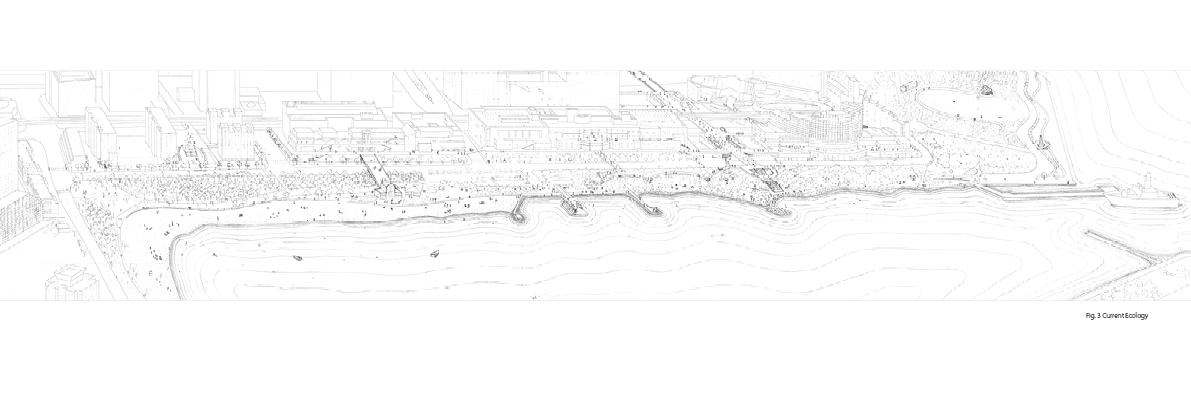
Odaiba, as an artificial island, started with a lot of locked Res communis, such as the water, beaches, plants etc. However, Odaiba was almost abandoned after the Second World War. The access to the island and its resources were also extremely limited, so few people went to the Odaiba area during that period. Then, the government wanted to change Odaiba area into a commercial center, building Lex communis such as piers and waterfront promenades along the coastline to attract more people. Because of this Lex communis, a series of Praxis communis appeared such as photography. As such, the Odaiba waterfront reached the current ecology balance. However, the frequency and the variety of the Praxis communis is not sufficient since the Lex communis provided is not efficient and the Res communis cannot be fully unlocked. The proposal of our group is the redesign of the existing piers. We used the same structure systems and designed a series of piers with different topics to provide for various experiences for both local residents and tourists. And, more activities (Praxis communis) will happen along the waterfront by the enhanced Lex communis. As such, more Res communis will be unlocked. Consequently, the ecology after the proposal will become more lively and dynamic.
Student: Yi Shi
- All
- 2009_Behavior Around Windows
- 2012_Bike Town Tokyo
- 2013_Without Venturi
- 2014_Tokyo Pallazzo
- 2015_Architecture for Biodiversity
- 2016_Constructing Tokyo Commons
- 2017_Slowgraming Tokyo
- 2018_Yamanote-line Lab
- 2019_Thing of Modernity
- 2019_Variete / Architecture / Desire
- 2019_Window Scape 8 -A Window Between Ethnographic Relations and Industrial Society-
- 2020_Non-Binary City
- 2020_Ochestrating Unpredictablity in Tokyo
- 2021_Ugly Architecture?
- 2022_Miss Behavior
- 2023_Sing a Song
- 2024_The power of drawing
- Thing of Modernity – Mapping the Micro-geography of Everyday Environments