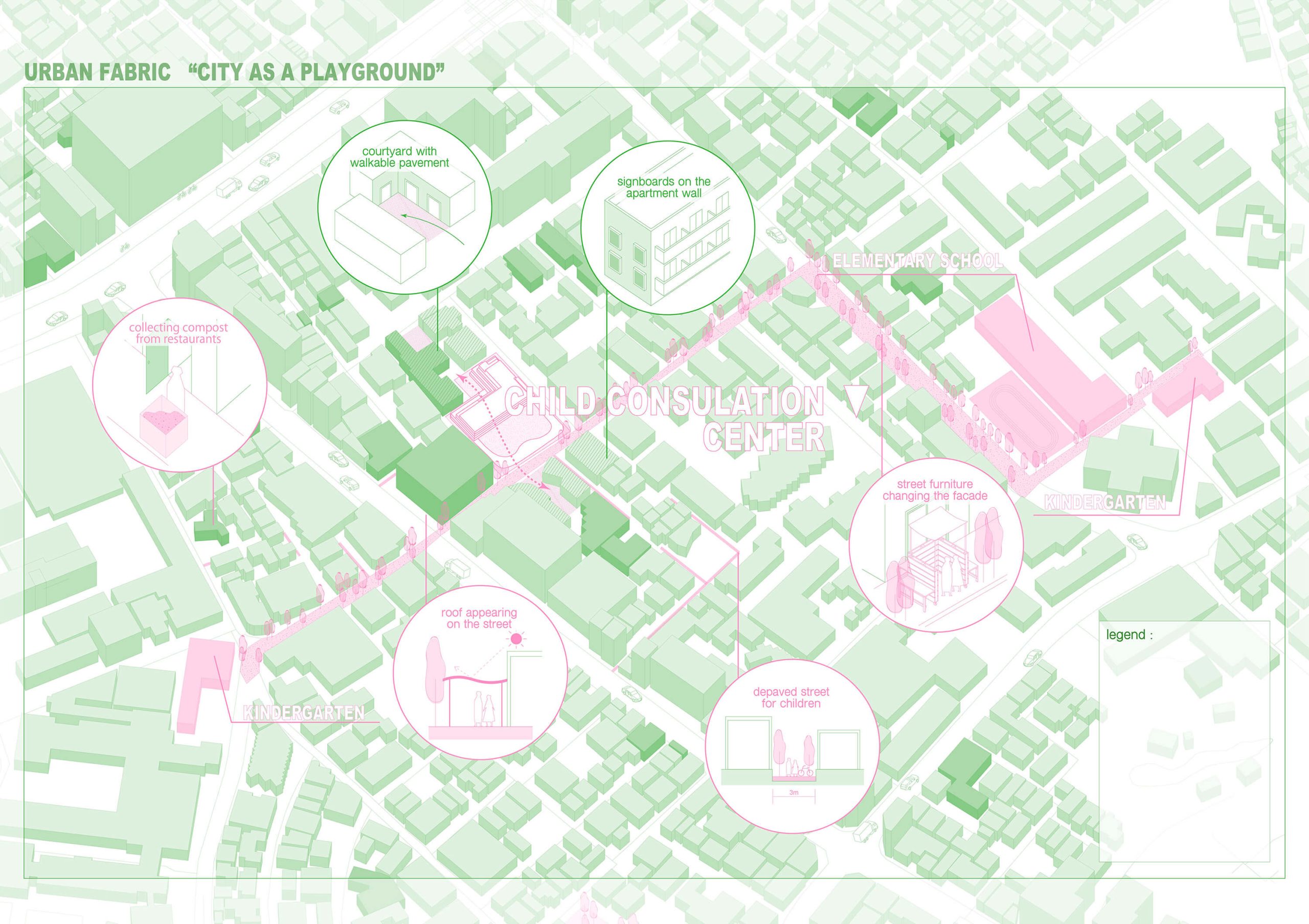
Low wages, long working hours, and an increasing burden due to the excessive demands of parents cause a shortage of childcare workers. There is also the NIMBY problem, where residents’ opposition to the construction of childcare facilities has forced them into poor conditions, such as under elevated railway tracks. All of these problems are caused by the fact that childcare is regarded as someone else’s business. A binary pits child welfare against economic activity and living conditions and excludes it. We tear away the asphalt that is paved by egoism. The soil opens up childcare, which used to be on the “other side” of the wall, to the city through activities such as composting, fieldwork and, children’s play in the soil.
Student: Yutaro HOSHINO
- All
- 2009_Behavior Around Windows
- 2012_Bike Town Tokyo
- 2013_Without Venturi
- 2014_Tokyo Pallazzo
- 2015_Architecture for Biodiversity
- 2015_Sagata Livelihood Observatory Public Drawing
- 2015_佐潟なりわい観測舎
- 2015_佐潟なりわい観測舎
- 2015_佐潟なりわい観測舎
- 2016_Constructing Tokyo Commons
- 2017_Slowgraming Tokyo
- 2018_Yamanote-line Lab
- 2019_Thing of Modernity
- 2019_Variete / Architecture / Desire
- 2019_Window Scape 8 -A Window Between Ethnographic Relations and Industrial Society-
- 2020_Non-Binary City
- 2020_Ochestrating Unpredictablity in Tokyo
- 2021_Ugly Architecture?
- 2022_Miss Behavior
- 2023_Sing a Song
- 2024_The power of drawing
- MADE IN TOKYO
- Thing of Modernity – Mapping the Micro-geography of Everyday Environments
- 佐潟なりわい観測舎